“WorldView Opens New Horizons for Us”: A Conversation with Students
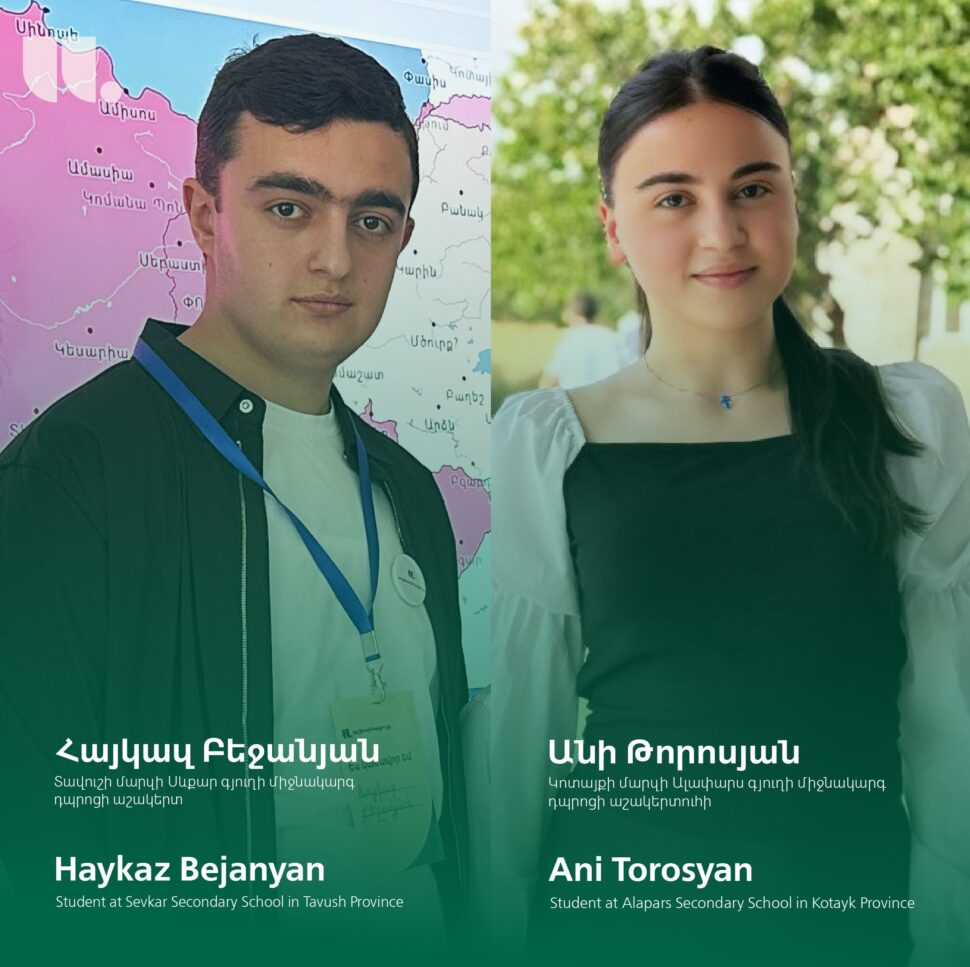
Haykaz Bejanyan is an 11th-grade student at Sevkar Secondary School in Tavush Province. His dream is to become a doctor — to help people. But before becoming a good professional, he believes, one must first be a good person and a good citizen. And to be a good citizen of Armenia, he says, one must know their own history. In that journey, his trusted companion is the WorldView educational content on the Brainograph platform.
“We first started using it in Armenian History classes back in 9th grade. At first, I thought it was a translated version of some foreign website,” Haykaz recalls with a smile. “When I realized it was Armenian-made, I was both surprised and proud — it’s amazing that such advanced technologies are being created right here in Armenia.”
Lessons with WorldView are more engaging, visual, and memorable. Haykaz notes that the information on the platform is accurate and reliable, and the variety of tools inspires curiosity and helps students grasp even complex material with ease.
“My favorite feature is the timeline. You can move it back and forth to see how territories changed over time. When we discuss wars or shifting borders, I love seeing those changes directly on the map — it makes the lesson more vivid and easier to understand.” Among his other favorites are the ruler, which shows real distances between countries or regions, and the sticky notes tool, which allows students to add comments directly on the map. “When we work with maps, we no longer need to take notes in our notebooks. We can make marks right on the map and revisit them anytime. It’s much more convenient,” says Haykaz.
Hundreds of kilometers away, in the village of Alapars, Kotayk Province, another student — Ani Torosyan, a 10th-grader at Alapars Secondary School — shares the same enthusiasm.
Both students agree: WorldView captivates them with its visuals, diversity of content, and interactive tools. Ani, who has been using the platform since 8th grade, says it always keeps her one step ahead. “With WorldView, we learn much more than what’s in the textbook. We explore topics through pictures and videos and even play educational games that help us reinforce what we’ve learned. Without WorldView, lessons would feel monotonous. With it, even those who weren’t very interested before get involved,” she admits.
Ani has mastered many of the platform’s tools and often helps her classmates. She proudly notes that in their class, everyone knows at least one or two tools well. They began using WorldView in geography lessons and later carried out a project with their teacher — a project that won their school a long-awaited Smart Board.
“That was a big victory for us — we were so happy and proud. We learned that when we set a goal and work together, we can achieve it. WorldView and the Smart Board open huge opportunities for us. Bringing new technologies into schools is essential for our future,” says Ani.
In today’s digital world, knowing how to navigate technology is no longer optional — it’s a necessity. Students like Haykaz and Ani prove that with the right tools, learning can be both meaningful and inspiring.
And as for the future doctor’s wish? Haykaz has one suggestion for the WorldView team: “I’d love to see chemistry and biology added to the platform one day.”



 Antarayin 164/1