The School as a Creative Laboratory and Cultural Platform
On February 18, the meeting of the winning schools of the Smart Boards for WorldView Competition (SBWC) 2025 took place, providing a space for the exchange of experience and inspiration. Schools from different regions of Armenia gathered on one platform to present the journey of their project-based work—their achievements and the challenges they had overcome.
Once again, this day confirmed that project-based learning can transform the classroom, turning it into a living, thinking, creative, and research-oriented environment.
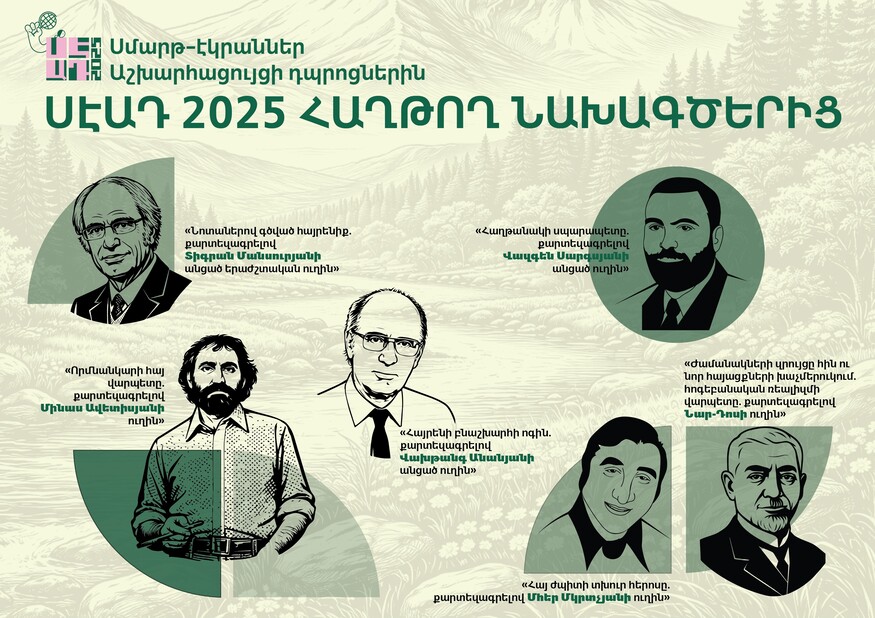
Artik Basic School No. 2 presented the project “A Homeland Composed in Notes: Mapping Tigran Mansuryan’s Musical Journey.” Students became researchers, working in the school archive, visiting the cultural center, studying Mansuryan’s childhood path, and conducting interviews with his friends and classmates.
Anna Khachatryan, a teacher at Artik Basic School No. 2, noted in her speech that the success of the project work was due to consistent guidance and team support: “If it were not for your work and your consistent guidance, this project would not have succeeded. Although I have many years of teaching experience, it was during this work that I discovered anew a number of my students’ abilities—their creative thinking, initiative, teamwork skills, and their ability to express their own ideas. This process became a unique learning experience not only for the students, but also for me. It proved how important it is to reveal children’s potential through creative projects. A well-guided project can turn into a profound educational experience.”
Kaputan Secondary School, with the project “The Commander of Victory: Mapping Vazgen Sargsyan’s Path,” created not only a historical, but also a civic education platform. Students visited Vazgen Sargsyan’s house-museum, the military academy, and the institution where he studied, and met with relatives and close associates, who presented not only the statesman, but also the person—with his principles, loyalty, and sense of responsibility.
The visit to Yerablur became a lesson in silence and dignity, and the phone conversation with writer Shermazanyan revealed Sargsyan also as a thinker and a writer. All this became a living school of civic consciousness.
The M. Nalbandyan High School presented the project “The Armenian Master of Mural Art: Following Minas Avetisyan’s Path,” bringing art out of the pages of textbooks and into real life. The project leader, Anush Mikayelyan, emphasized in her speech that those who can make others happy are truly happy, and that the WorldView educational platform became exactly such a platform for them—opening new opportunities and inspiring creative work.
She noted that the project work was an important experience in discovering Minas Avetisyan not only as a great painter, but also as a person—with his worldview, difficulties, and creative struggle. Students quickly mastered the platform’s tools, independently organized meetings, collected materials, and shaped the final outcomes, demonstrating a high level of teamwork and research skills. During the project, they visited Jajur to study Minas’s life from his birthplace to his creative career, and then applied to the National Gallery of Armenia to obtain permission to carry out filming in the Minas Museum.
At the museum, they heard interesting stories, including the story of the creation of the painting “Beet Harvest,” when, during his diploma defense, Minas was nearly given an unsatisfactory grade because the characters were considered “sad,” and he added smiles on the spot, defending his work.
The final outcomes were diverse and impressive:
-
- a film, “One Day with Minas,”
- thematic puzzles,
- performances for younger students,
- a study of the mystery of Minas Avetisyan’s death, with their own analyses.
This project became a path of discovery, where students learned to work with sources, analyze and present facts, understand the human image of the artist, and pass cultural values on to others.
Dilijan Vahagn Ananyan Secondary School, with the project “The Spirit of the Native Landscape,” brought together literature, love for the homeland, and a creative approach. Students wrote fairy tales in the Shamakhyan dialect, mapped Ananyan’s path, and staged “The Prisoners of Hovazdzor” through a puppet theater, also involving younger students. All this turned not only into a literary discovery, but also into the cultivation of love for nature and the homeland, turning literature into a living culture.
Zoravan Secondary School, with the project “The Tragic Hero of the Armenian Smile: Tracing Mher Mkrtchyan’s Path,” revealed the great actor’s human and cultural image. Students visited the house-museum, walked the streets of Gyumri following the traces of the films, created performances, and studied the Gyumri dialect, breaking linguistic stereotypes. The project became a path toward rediscovering identity, roots, and cultural memory.
Yerevan High School No. 198, with the project “A Dialogue of Times at the Crossroads of Old and New Perspectives,” carried out an in-depth literary study, revealing Nar-Dos as a thinking person and a chronicler of his time. After two months of research, students were able to establish contact with the writer’s descendants, conduct interviews, and create a film recreating the atmosphere of old Tbilisi. Within the framework of the project, an interview was also conducted with actor and playwright Armen Santrօsyan. He was surprised to see that the students had read almost all of Nar-Dos’s works and had studied his world in depth.
The students also prepared a short film, trying to make the visuals resemble the streets of old Tbilisi, where part of the writer’s life had passed. This project became an interesting research journey, bringing together literature, history, and modern creative technologies.
This meeting once again proved that when a school becomes an open system—where students explore, create, question, and discover—education gains real value. This phase of the SBWC showed that smart boards are not just technology; they are a bridge to new educational thinking, new methodology, and the formation of a new generation.
We thank all the schools, teachers, and students for this inspiring journey.
You are shaping a school where education lives.



 Antarayin 164/1